On Friday, I attended Tech Leadership Unplugged, and one of the main topics we discussed was “Pushing for excellence without triggering burnout”. The format was a small roundtable discussion led by one of my idols, Meri Williams, and organised by Grace Duffy. I loved this conversation because understanding and acting on burnout is a cornerstone of leadership. I’ll share some resources and questions we used to kickstart conversations, some ideas I loved from other leaders, and my thoughts on burnout.
- Understanding the drivers of burnout
- How do we prevent or, failing that, identify burnout?
- What if we fail to spot it, stop it or if we inherit a team where someone is already burnt out?
- How can we watch for burnout in our organisation if we’re not managing ICs directly but managers?
- A message for anyone feeling burnt out
- Closing thoughts

Understanding the drivers of burnout
When we think about burnout, the first thing that might come to mind is overwork and long hours. But actually, there are more drivers to burnout. This short article by Cate Huston is an excellent read to introduce yourself to six causes of burnout:
- Lack of control.
- Lack of reward.
- Absence of fairness.
- Lack of community.
- Conflict in values.
- Work overload.
How do we prevent or, failing that, identify burnout?
Knowing the 6 six drivers of burnout can help you spot patterns in your teams and organisation and significantly help you prevent it. Throughout the years, I’ve realised that there are specific patterns in which these factors tend to cluster together, and when you spot one of the patterns, you need to act fast. Here is an example of a pattern I’ve seen multiple times:
- Team A has been working on projects with tight deadlines and little say in what features/scope they must deliver (lack of control). Because of the tight deadlines, they see no other option but to compromise on quality and cut all experimentation, which goes against how they believe things should be done (conflict in values). Also, because of the tight deadlines, they have been working long hours (work overload). When the project is delivered, they expect recognition and reward from their senior leaders, but it doesn’t arrive or is underwhelming (Lack of reward). This is a textbook case of a team heading for burnout.
One of the most effective ways to identify a person burning out is to look for sudden changes in behaviour. e.g. Is someone who is usually talkative now quiet? Ensure you reach out when you notice these behaviour changes and check if everything is alright. I can’t stress enough how nothing can replace connecting with your team and extending compassion to them.
Another helpful tool to consider burnout is the relationship between energy levels and positivity (I’m not sure where this idea originated to link the reference, but if you do, please DM me). I’ve drawn the following image of four quadrants but avoided the usual labels (e.g. Toast) because I’m not a fan of them:
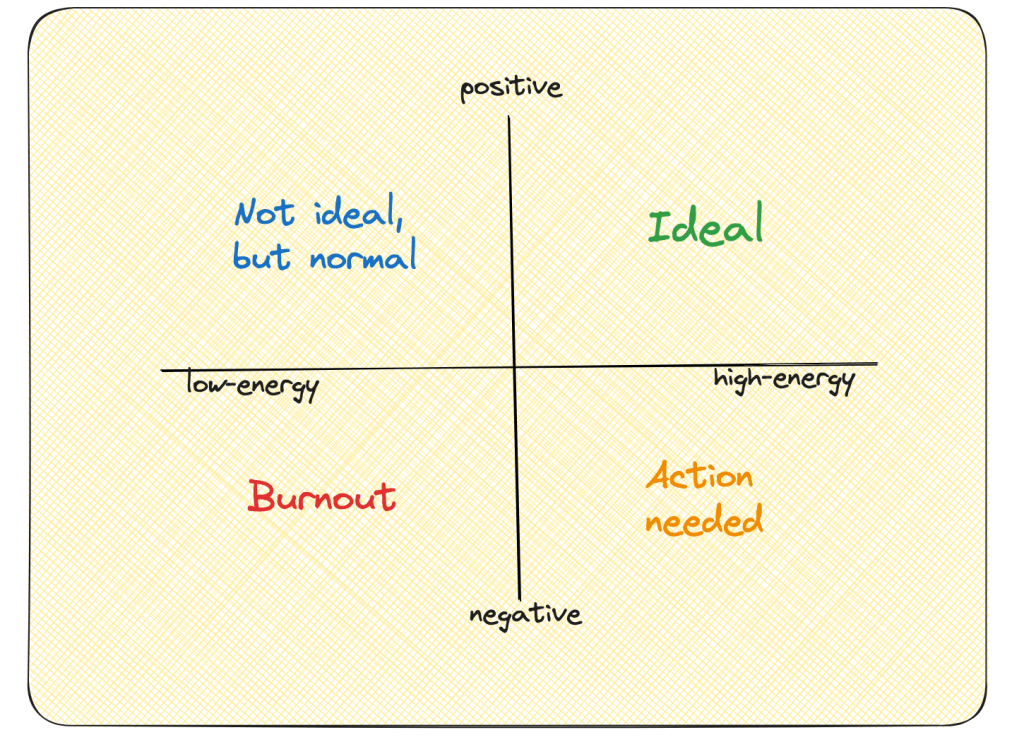
Ideally, we would like all our team members to be High-energy and Positive forever, but that’s impossible given that we’re all human and not robots. An oscillation between High-energy+Positive and Low-energy+Positive is quite normal and healthy. People’s energy levels will oscillate as they navigate life, e.g., moving houses, getting sick, having kids, grieving, etc.
Things start to get worrying when we get to the Negative territory. The High-energy+Negative individual will vocalise what is wrong; they will complain about their pains and frustrations. This person is usually incredibly misunderstood; deep down, they still care about their job and improving things. If you can address their pain points successfully, you can give them back their positivity and prevent them from burning out.
What if we fail to spot it, stop it or if we inherit a team where someone is already burnt out?
I won’t sugarcoat it; there are no quick fixes for burnout. The way out for you and your report will likely be a long road, and you will have to travel it together with intention and oodles of communication.
It is essential to understand that time off, even though it might be part of the solution, is not the whole solution. You need to understand why this person got burnt out, what they need to heal, and what they will need when they return to their daily commitments.
People can feel complex emotions accompanying burnout: guilt towards their team with a sense that they have let them down, an identity crisis if their identity is tightly linked to their work and career, or fear that they will never feel like themselves again. Remove any stigma around getting professional help, and if your company has the resources to pay for it, this is a valuable thing to offer.
Last but not least, make sure you help them ease back into it. Make a plan in which they start working reduced days and slowly but steadily work their way up to the full speed. Patience is key.
How can we watch for burnout in our organisation if we’re not managing ICs directly but managers?
Tooling can greatly help; I personally like Peakon, which is an excellent tool for sending periodic surveys. The best thing is that answers are benchmarked, which gives you perspective; you can read about that here. Responses are anonymous, of course. You can configure how often you would like to run these. First-hand, I’ve seen these sent monthly and quarterly, and I think monthly is the wiser option.
I loved that Meri, CTO at Pleo, mentioned she keeps a Slack channel called #speaktruthtoMeri where people can have a public forum to raise problems. It’s a fantastic way to spot patterns! Another essential is to strive to build a culture where people feel they can message you directly with issues. If you don’t have this, it will be harder to know when the house is on fire, or you’ll find out later than you wish.
Managers are the sensors of your organisation.
Last but not least, remember managers are the sensors of your organisation. They are the best positioned to spot burnout and your first line of response. Invest in their training and development, and make sure they understand burnout inside out. If you know some of your managers might struggle to spot it, pay extra attention to those teams while you coach those managers.
A message for anyone feeling burnt out
If you’re healing from burnout or you identify these drivers of burnout in yourself right now, I have the following thoughts to offer:
- It’s your manager’s job to spot burnout and address it. If they have spotted it and are trying to help, help them help you; it’s on you to decide what you need to heal and communicate this clearly.
- Sometimes, we can’t change the environment that makes us sick. It’s good to take a step back. I don’t recommend staying in the good-on-paper-bad-on-your-soul job.
- You deserve your own efforts, but you also deserve rest. You can take a break if needed, and your career will be fine.
Closing thoughts
Burnout is a topic very close to my heart. Several years ago, I suffered from a severe burnout when I was still a software engineer. Looking back, I steadily ticked all six drivers of burnout for months; it was a textbook example, but back then, I didn’t know how to identify it, and neither did my manager or skip manager. I had to take a sabbatical and reconnect with my values, rest and recover. It was a challenging experience for me; so much of my identity until then was coupled with my job, and now I was not fit enough to do it. Who was I if I wasn’t working? Nevertheless, as most challenges do, it fuelled deep-rooted learnings and cemented a valuable lesson. What I took from that experience made me a better leader now.
 giselarossi.co.uk
Leave a comment